

You checked the water last week. Now the level is lower, and there is no obvious puddle. Is the hot tub leaking, or has the water simply evaporated?
Both are possible. Warm water naturally evaporates, people carry water out on their swimwear, and lively jets can send a surprising amount over the side. A steady drop when nobody has used the tub is different. That deserves a closer look.
This guide will help you separate normal water loss from a likely leak, make a few safe checks and know when to call a spa engineer. If you are still learning how the main parts work, our guide to how a hot tub works is a useful companion.
Why does a hot tub lose water?
A falling water level does not always mean a split pipe. There are three broad causes:
- Evaporation: warm water escapes into the air as vapour.
- Splash-out and bather carry-out: water leaves during normal use.
- A leak: water escapes through a loose fitting, worn seal, damaged pipe or another fault.
Rain can blur the picture by topping the tub up, while a long soak with several people can make a sudden drop look worse than it is. Start with what has happened around the tub, not with a screwdriver.
When evaporation is the likely cause
Evaporation tends to be gradual. It rises when the water is much warmer than the air, the cover is left open, the wind is strong or the jets and air blower run for a long time. Cold, dry weather can also draw more moisture from the water than you might expect.
A sound, well-fitting cover slows that loss when the tub is not in use. It also helps retain heat. Check that it sits evenly and has not become bowed, waterlogged or damaged.
When splash-out explains the drop
Think back to the last few soaks. Children playing, several adults getting in and out, high water before bathing or jets aimed towards the surface can all send water over the edge. Wet swimwear and towels carry more away.
If the level only falls after busy use and then stays steady, splash-out is a stronger suspect than a plumbing leak.
When a leak becomes more likely
A leak is more likely when the water keeps falling while the covered tub is unused. Other clues include a wet patch that returns in dry weather, water inside the cabinet, a damp or soft base, unexplained gurgling, weak or surging jets, or the need to top up far more often than usual.
One clue is enough to investigate. It is not enough to identify the faulty part, though. Water can travel along pipework or insulation before it appears, so the first damp place you see may not be the source.

Start with a simple water-level check
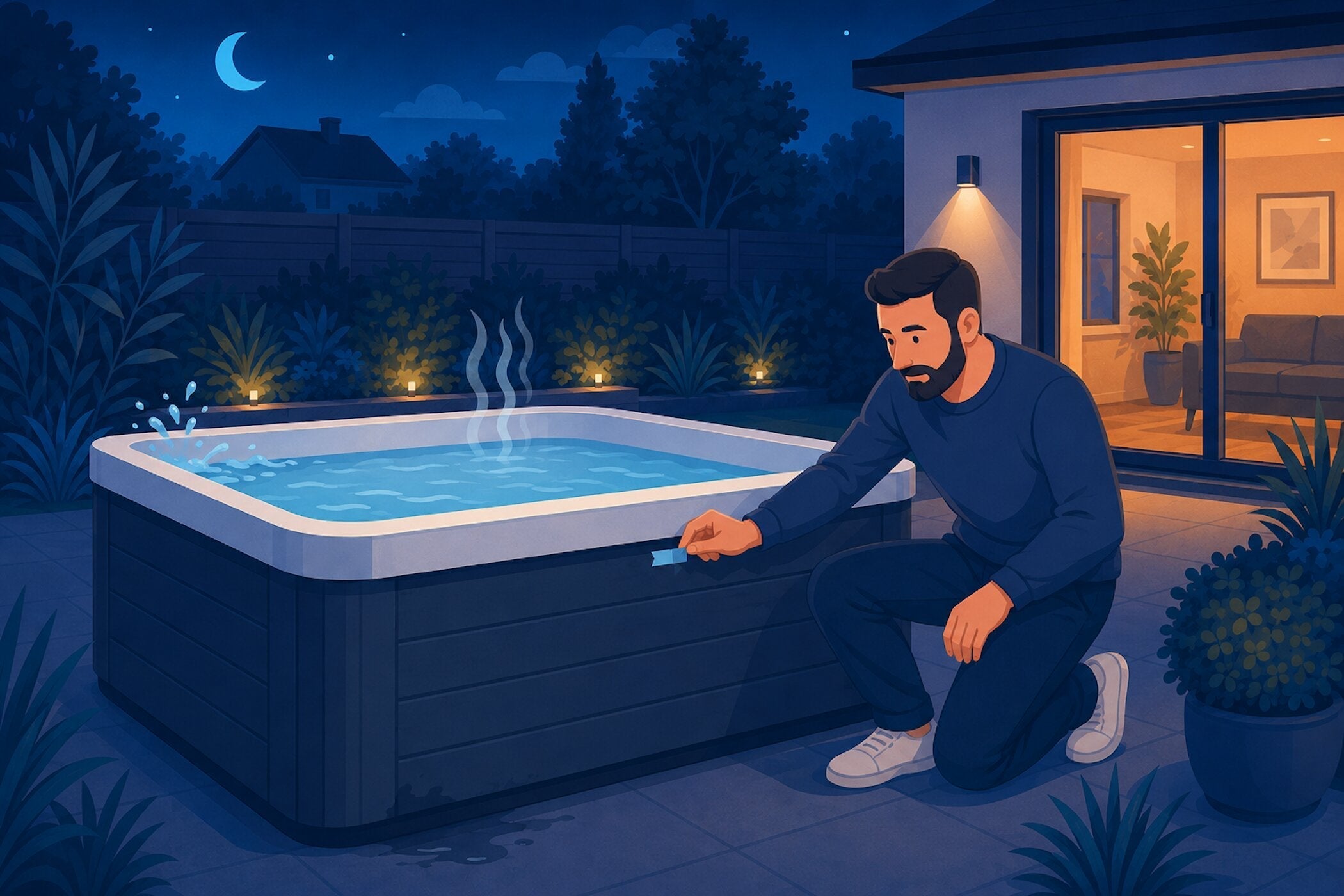
Pick a period when nobody needs to use the hot tub and rain is not expected. Bring the water to the level stated in the manual, fit the cover and mark the waterline with a small piece of removable tape on the outside of the shell or cabinet. Do not put adhesive below the waterline.
Check the level again after a set period. Note the weather, whether the heating or filtration cycle ran, and whether anyone opened the cover. If the level stays close to the mark, recent bathing or evaporation may explain the earlier drop. If it continues to fall with the cover on and no bathers, treat a leak as the working theory.
Never let the water fall below the minimum level in the manual. Low water can interrupt circulation and may cause the pumps or heater to stop. This matters even more in freezing weather, as our guide to using a hot tub in winter explains.
Keep a short record
Take a clear photo of the marked level each time you check it. Note whether the pumps were running and whether the ground was already wet from rain or bathing. A few simple observations give an engineer far more to work with than “it seems lower”.
Safe checks you can make around the hot tub
These checks are visual. Follow your own manual because access and shut-down steps vary between hot tubs. If water is near electrical equipment, the RCD keeps tripping or you are unsure how to isolate the supply, stop and call a competent professional.
1. Check the cover and water around the rim
Look for a cover that no longer closes evenly. Check whether jets, waterfalls or fountains are aimed above the waterline. Dried mineral marks on the shell or paving can show where water has repeatedly splashed.
Also check the cover lifter. A wet cover folded back after use can drain onto one side of the tub and create a puddle that looks like a leak.
2. Inspect the drain cap and visible exterior
Make sure the drain cap is secure, using the method in your manual. Look around the cabinet base for a damp trail, drips or staining. Do this in dry weather and before anybody bathes, so old splash water does not confuse the result.
Do not tighten fittings with force. Plastic parts can crack, and some unions are designed to be hand-tight only.
3. Look at the base and surrounding surface
Water should not collect under a hot tub. A level, firm base supports the filled weight and makes unusual wet patches easier to spot. Our guide to choosing a hot tub base explains why drainage, level and access all matter.
If the tub sits on decking, do not crawl beneath it or remove structural boards. Look from a safe position and arrange professional access if needed.
4. Check the equipment area only if the manual allows it
Some manuals let owners remove a service panel for a visual check. Others do not. Isolate the hot tub exactly as the maker directs before opening any permitted panel, and keep wet hands away.
Use a torch to look for drips, white mineral deposits, rust staining or damp insulation around visible pumps and plumbing. Do not open the control box, touch wiring or run the tub with a protective panel removed. Water and electricity are not a DIY combination.
What to record for the engineer
Photograph the damp area without touching components. Note whether the leak appears only while a pump runs or also when the tub is idle. Record any error code exactly as shown on the control panel.
5. Notice where the water level settles
A leak may slow or stop when the water drops below the faulty jet or fitting. That can help an engineer narrow the search. Do not deliberately leave the tub draining to find the point. Switch it off as the manual directs before the water reaches the minimum operating level, then ask for advice.

Common places a hot tub can leak
The visible wet patch may be some distance from the actual fault. These are common areas an engineer may inspect.
Pump seals and unions
A pump has seals and connections that can wear, loosen or become damaged. A leak may appear only while the pump is running, or it may continue as a slow drip when the tub is idle.
Heater and plumbing connections
Heater unions, valves and pipe joints can all leak. Mineral deposits often build where a small drip has dried many times. These parts sit close to electrical equipment, so leave testing and repair to a spa engineer.
Jets, lights and shell fittings
Each fitting that passes through the shell relies on a seal. Age, movement or damage can let water escape around it. The level at which water loss slows can sometimes point towards the affected fitting.
The drain assembly
A loose cap, worn seal or damaged drain body can cause a steady loss near the bottom of the tub. Check only the user-accessible parts described in the manual.
Pipework or shell damage
Frozen water can split plumbing. Impact or poor support may damage other parts of the spa. Shell cracks are less common than loose fittings or worn seals, but any crack needs professional assessment before the tub is used again.
Can you use a hot tub that is losing water?
Pause use until you know why the level is falling. Do not use the tub if water is near electrical equipment, the RCD or circuit breaker trips, the level is below the manual's safe range, a pump sounds starved of water, or the base has become unstable.
Repeatedly topping up is not a repair. Fresh water also changes the water balance, so each top-up can mean more testing and adjustment. Our hot tub water care guide explains the basic checks after adding water.
If the loss is clearly from a busy soak and the level remains stable afterwards, refill to the manual's mark and test the water before bathing. If there is doubt, keep the cover on and call your dealer or a qualified spa engineer.
How to reduce avoidable hot tub water loss
- Keep the cover closed and secured when the tub is not in use.
- Replace a cover that no longer seals or has become damaged.
- Keep jets and water features aimed into the tub.
- Do not overfill before several people get in.
- Check the water level as part of your regular care routine.
- Look for recurring damp patches before they become a larger problem.
- Follow the manual for winter use or a full winter shutdown.
Regular cleaning is a good time to look over the shell, cover and accessible fittings. Our guide to cleaning your hot tub can help you build that check into the routine.
Hot tub water loss questions
How much water loss is normal?
There is no useful one-size-fits-all figure. Water temperature, air temperature, wind, cover condition, jet use and the number of bathers all change the result. Track your own tub when it is covered and unused. A continuing, unexplained drop is the key warning sign.
Can a damaged cover make the water level fall?
Yes. A cover that is bowed, torn or no longer fits can let more warm, moist air escape. It will not explain a returning wet patch beneath the cabinet, though, so check both clues.
Why does the level fall only when the jets are on?
Water may be splashing out, a water feature may be aimed too high, or a pressurised part of the plumbing may leak only while a pump runs. Record what you see and tell the engineer. Do not run the tub below its safe level to repeat the test.
Should I use leak-sealing liquid?
Only if the hot tub maker or a qualified repairer says it is suitable for the specific fault. A sealant may hide the symptom without fixing a damaged component, and it may not be compatible with every system.
Hot tub losing water? Take the safe route
Start with the simple explanation. Think about recent use, check the cover and mark the waterline while the tub is covered and unused. If the level keeps falling, look for damp clues around the drain, base and any owner-accessible area.
Stop before the water reaches the minimum operating level. Keep away from wet electrics and do not dismantle plumbing or control equipment. A clear record of the water level, weather, pump activity and visible damp will help a spa engineer find the fault faster.
If you need help making sense of what you have found, H2O Hot Tubs can point you towards the right next step.


Share: