

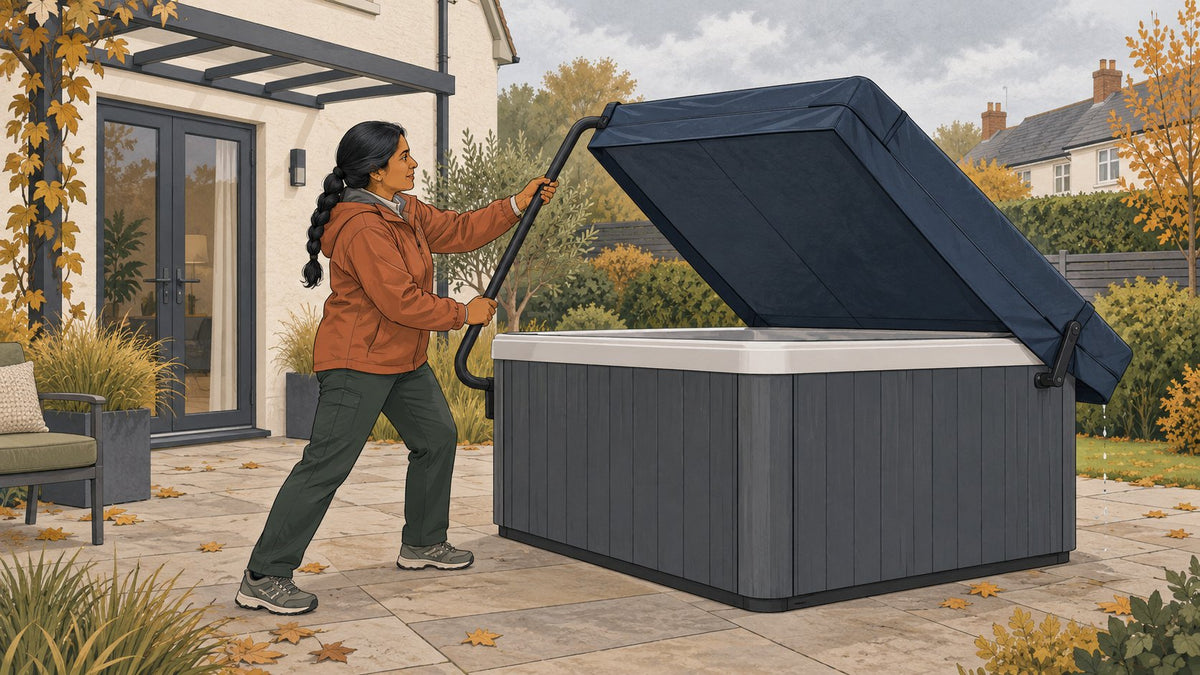
Why has my hot tub cover become so heavy?
A hot tub cover that has become much harder to lift is usually holding water somewhere inside it. A little condensation on the underside is normal. A cover that stays heavy, feels uneven or sags towards the water is not.
The most common cause is a waterlogged foam core. Insulated covers normally contain rigid foam wrapped in a moisture-resistant barrier, with an outer jacket around the whole assembly. If the barrier or foam is damaged, warm vapour from the spa and rain from outside can reach the core. The foam then takes on moisture and becomes heavier over time.
Do not force a suddenly heavy cover onto a lifter or try to carry it alone. Ask another adult to help, support both halves and check the lifter for strain. If the cover is cracked, badly bowed or no longer closes securely, keep children and pets away from the spa until it has been made safe.
Is it normal condensation or a waterlogged hot tub cover?
Finding beads of water on the underside does not prove that the cover has failed. The air above hot water is warm and humid, so some vapour will condense on a cooler surface. That surface moisture should be fairly even and should not make the cover progressively harder to lift.
Waterlogging affects the inside of the cover. These signs make it more likely:
- one half or one corner feels much heavier than the rest;
- the weight remains after the outside has dried;
- the cover bows down or pools rainwater instead of shedding it;
- the hinge, seams or underside are split, brittle or punctured;
- the foam feels soft, broken or misshapen through the jacket;
- there is a persistent musty smell inside the jacket;
- the cover no longer sits flat around the spa rim.
A cold wet week can leave the outside of any cover damp, so compare it with how the cover normally feels. The change matters more than a universal weight figure. Covers vary greatly in size, foam thickness and construction.

How an insulated hot tub cover works
Most folding insulated covers have several layers, although the exact design varies by maker:
- Foam core: the rigid insulating section that slows heat loss.
- Moisture barrier: a sealed wrap intended to keep water vapour away from the foam.
- Outer jacket: the weather-facing material, often with handles, skirts and fastening straps.
- Hinge and reinforcement: the central fold and any support built into the cover.
A well-fitting insulated cover forms a barrier between hot water and cooler air. That is why cover condition matters to heat retention, not just appearance. Manufacturer guidance from Master Spas also stresses the value of dense foam and a snug fit.
The moisture barrier is important because foam and warm water are separated by only a short distance. Once water gets through a failed seam, split wrap or cracked core, drying the outside does not repair the route it used to get in.
What causes a hot tub cover to become waterlogged?
Damage to the foam or its sealed wrap
Someone sitting, standing or placing a heavy object on the cover can crack the core even when the jacket still looks tidy. Storm debris, sharp branches and rough handling can cause punctures. Never treat an ordinary spa cover as a seat or storage shelf unless its maker clearly states that it is designed for that load.
Wear around seams and the hinge
The hinge flexes whenever the cover is opened. Handles and skirts are pulled, and the underside is exposed to warm moist air. Small failures around these high-use areas can give water a path towards the core.
Standing rainwater
A sound tapered cover should shed rain. Pooling water adds load and may point to a sagging or broken core. Remove leaves and debris so they do not block drainage or hold damp material against the surface. Do not push down hard on a puddle, as that can put more stress on the foam.
Sun, frost and harsh cleaning
Outdoor materials age under ultraviolet light, temperature changes and winter weather. Unsuitable cleaners can also dry or weaken some jackets. Use only the cleaning and protective products approved for your cover material.
Poor water care
Water balance and treatment practice affect the underside environment. Keep pH and sanitiser within the range stated for your spa, and follow the product instructions about leaving the cover open after treatment. Our hot tub pH guide explains why guessing with chemical doses creates wider problems.
Can you dry out a waterlogged hot tub cover?
You may be able to dry surface moisture or drain a small amount of water held inside the outer jacket. A saturated or damaged foam core is different. Drying can make it temporarily lighter, but it will often take on water again if the barrier or core has failed.
- Stop and assess the lift. If the cover is too heavy for safe handling, do not drag it by the handles. Get help or ask a dealer to inspect it.
- Choose a dry, clean place. Lay the cover on a non-abrasive surface where it is fully supported and cannot blow away.
- Check the manual. Some covers have zipped jackets and removable inserts; others are not meant to be opened by an owner. Opening the wrong section can damage the vapour barrier or affect the warranty.
- Inspect without cutting. Look for a split seam, puncture, broken hinge, cracked foam, damaged strap or water trapped in one side. Never cut the jacket or sealed foam wrap to speed up drying.
- Clean and air it as directed. For a suitable cover, wash off debris with a hose and use mild soap with a soft cloth. Rinse and dry both surfaces. Master Spas' cover-care guidance follows that basic method, but your own instructions take priority.
- Recheck after it has dried. If the cover is still unusually heavy, remains lopsided or becomes heavy again, the problem is probably inside the core.
An industry specialist consulted by Better Homes & Gardens notes that a damaged inner core may drain when removed, then absorb water again. That is why a sunny day is not proof of a lasting repair.
When should a heavy hot tub cover be replaced?
Replacement is usually the sensible route when the insulation or structure has failed, rather than when the surface merely needs cleaning. Arrange an inspection or replacement if:
- the foam is cracked, crushed, bowed or soft;
- the cover stays heavy after surface drying;
- water returns after a short drying attempt;
- the hinge or seams have opened around the core;
- the cover no longer seals around the rim;
- the fastening straps or locks no longer secure it;
- the weight makes normal handling unsafe;
- the cover is sagging low enough to touch the water.
A damaged handle alone may be repairable if an approved repair is available and the core is dry and sound. A cosmetic mark is not the same as structural failure. Ask the cover maker or hot tub dealer when you are unsure.

Can a waterlogged cover increase hot tub running costs?
It can, but there is no honest universal saving figure. A cover contributes to heat retention by reducing the exchange between warm water and outside air. If it is saturated, misshapen or no longer seals, its insulating performance may be worse than when it was sound.
The actual effect depends on the spa, cover design, outside temperature, wind exposure, water temperature and how often the cover is opened. Look for practical clues such as longer heating periods, more visible steam escaping at the edges or a cover that no longer sits flat. Our guide to lowering hot tub running costs explains the other factors that matter.
A poor fit can also let more evaporation escape. If the water level is falling faster than expected, do not assume the cover is the only cause. Work through the checks in our guide to a hot tub losing water.
How to stop a hot tub cover becoming waterlogged
- Use the handles for positioning, not dragging. Support the cover as your manual shows.
- Keep loads off it. Do not sit, stand or store items on an ordinary cover.
- Clear leaves and standing debris. Use a soft brush or cloth rather than a sharp tool.
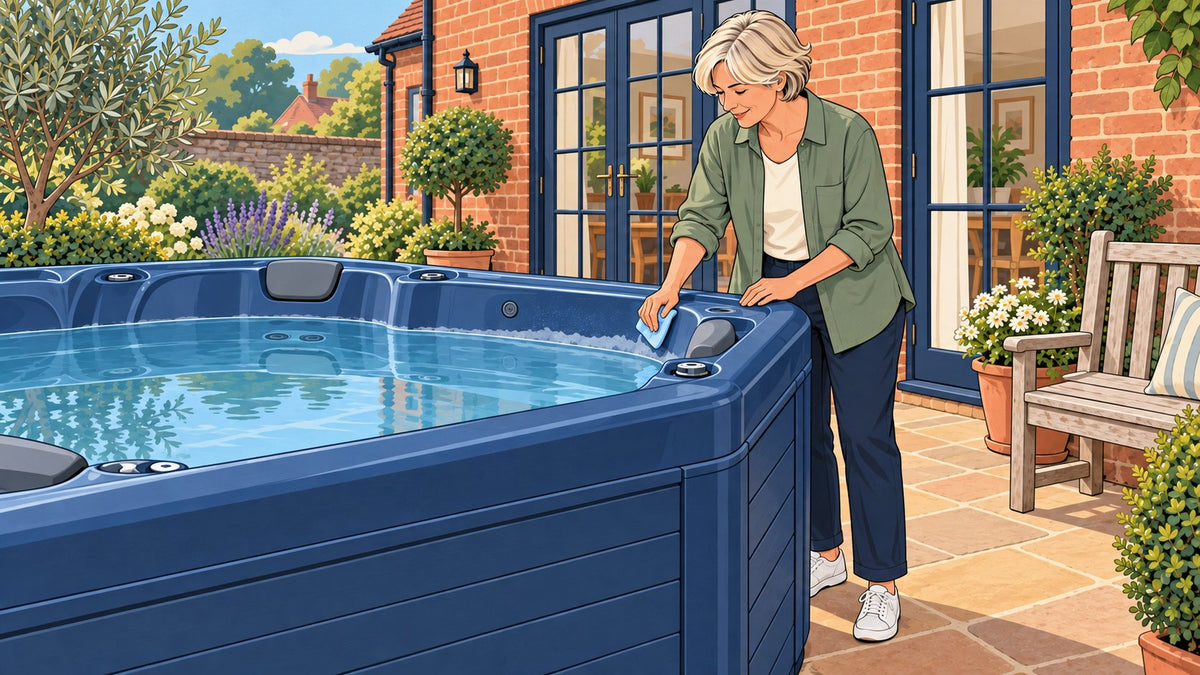
- Clean both sides gently. Mild soap, water and a soft cloth suit many covers, but check the material instructions first.
- Keep water balanced. Follow the spa and chemical labels, including any cover-open period after dosing.
- Use the fastenings. Secure the cover as designed, especially in windy weather. Fastenings are not a substitute for adult supervision or a separate safety barrier where one is required.
- Check the hinge, seams and underside. Catching a small split early gives you a chance to ask whether an approved repair is possible.
- Deal with snow safely. Remove it in line with the cover maker's advice and never attack ice with a sharp tool.
Winter exposes a cover to longer damp periods, frost and debris. Our guide to using a hot tub during winter covers the wider cold-weather routine.
How to choose a replacement hot tub cover
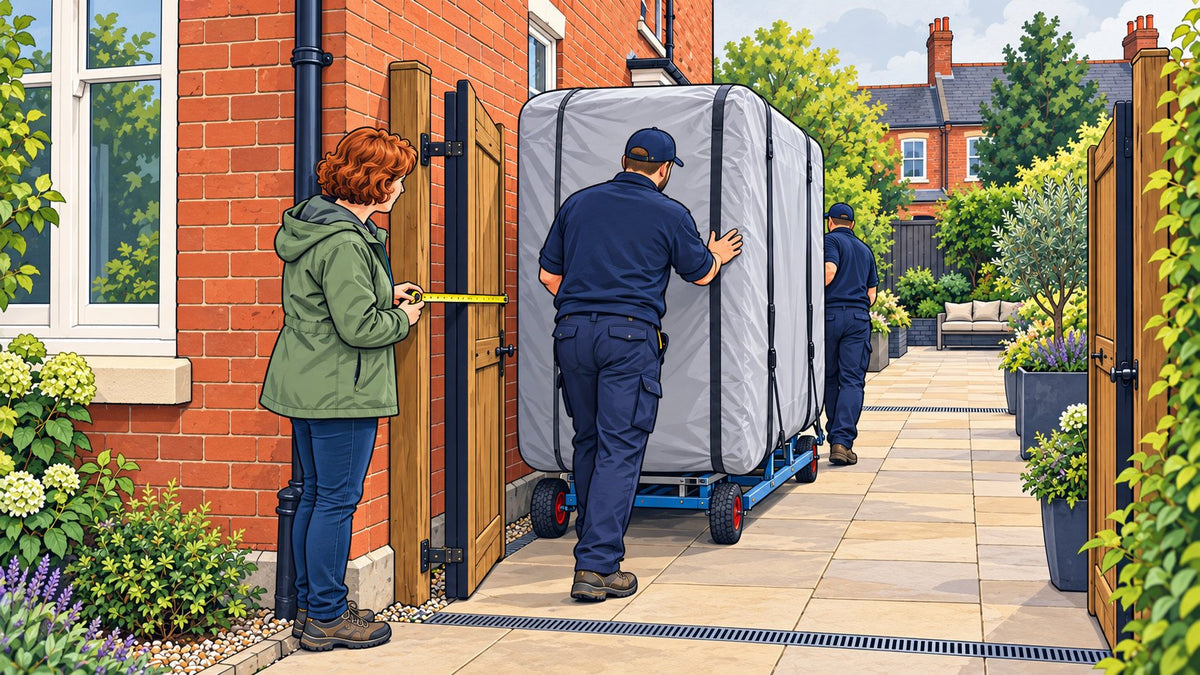
A replacement needs to fit the actual spa, not just a rough square measurement. Start with the make, model and serial details if they are available. Your dealer may already hold the correct specification.
If you need to measure, confirm the method before ordering. Common details include:
- the maximum shell width and length;
- the shape and corner radius;
- the direction and position of the fold;
- the skirt length;
- the location and length of fastening straps;
- clearance for a cover lifter or nearby wall.
The thickest cover is not automatically the best choice. It must suit the spa, climate, lifting method and person who will use it. Check the stated weight and confirm that any existing lifter is compatible. A snug, secure fit matters more than a vague promise such as “universal”.
Frequently asked questions
Why is only one side of my hot tub cover heavy?
That side may have a damaged moisture barrier, split seam or cracked foam core. It may also be holding surface water in the jacket. Support the cover, let the exterior dry and compare both halves. Persistent uneven weight points to an internal problem.
Can I replace only the foam inside my hot tub cover?
Some manufacturers supply compatible inserts, while others treat the cover as a complete assembly. The new foam must have the correct shape, strength, taper and sealed barrier. Do not improvise with building insulation or cut open a cover without checking the maker's instructions.
Can I keep using a waterlogged hot tub cover?
Do not keep relying on it if it is hard to handle, structurally damaged, sagging or no longer fastens securely. The risk is not only poorer insulation. A heavy cover can strain the lifter, handles and the person opening it.
Why does my new hot tub cover feel damp underneath?
Warm vapour can condense on the cooler underside, especially after use or in cold weather. Even droplets without extra weight or distortion are usually surface condensation. Check the water-care and ventilation instructions if the dampness is excessive or the material is changing.
Should I leave the hot tub cover open after adding chemicals?
Follow the product label and the spa manual. Many treatments require the pumps to circulate with the cover open for a stated period. Closing it too soon can trap strong vapours against the underside, while leaving the spa open and unattended creates a different safety risk.
Why is my hot tub cover so heavy? Treat the change as a warning
A wet underside can be normal. A cover that grows heavier, becomes lopsided or stops sealing deserves attention. Dry the surface, inspect it without cutting anything and follow the maker's instructions. If the core is cracked or keeps taking on water, replacement is usually more dependable than repeated drying.
The right cover should be manageable for the owner, secure when closed and matched to the spa. If you need help confirming the fault or measuring a replacement, speak to the team at H2O Hot Tubs with your model details and a few clear photographs.
Share: