

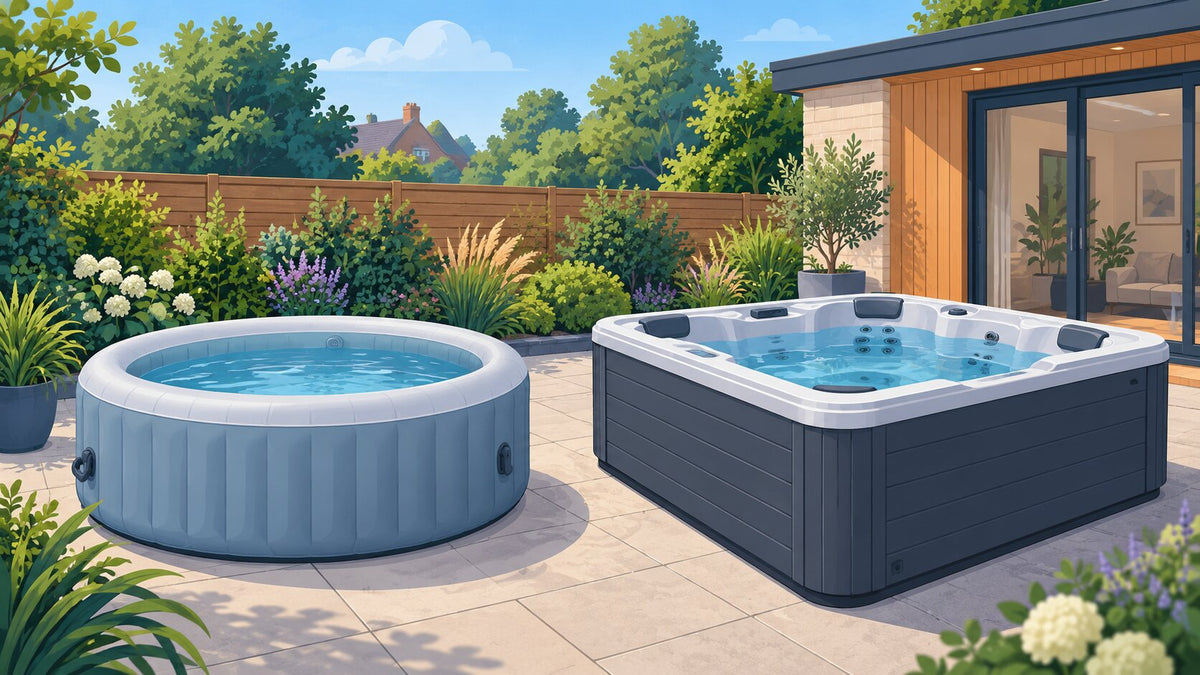
What changes when you choose an inflatable or hard-shell hot tub?
Inflatable hot tubs cost less to buy and can be packed away. Hard-shell spas cost more, but are built for regular use with shaped seats, filtration and insulation. Choose by the way you plan to use it, not price alone.
Here’s what those differences mean once the tub is in your garden.
Quick comparison: inflatable vs hard-shell hot tubs
| Feature | Inflatable hot tub | Hard-shell hot tub |
|---|---|---|
| Upfront price | Much lower; a low-commitment way to try hot tub ownership. | Several thousand pounds; a longer-term purchase. |
| Seating | Soft sides; bathers often sit on the floor, with seat inserts optional. | Moulded seats or loungers, with layouts that vary by model. |
| Bubbles and jets | Often air bubbles; some upgraded designs add water jets. | Usually dedicated water jets and pumps, with placement designed around the seats. |
| Heating | External pump and heater; cold starts can take time and performance varies in cold weather. | Integrated heater and controls; many are kept near a set temperature between sessions. |
| Insulation | Usually lighter and less insulated than a rigid spa. | Typically better insulated, though construction and cover quality still matter. |
| Running costs | Depend on electricity tariff, size, cover, weather and how often you heat it. | The same factors apply; better heat retention can help with frequent use. |
| Durability | Flexible walls can be punctured or worn, especially in sun or storage. | Rigid shell and cabinet are designed for a permanent garden installation. |
| Lifespan | Varies by model and care; replacement may be more likely than repair. | Often designed to be serviced, with pumps and other components replaceable, depending on model. |
| Maintenance | Needs water treatment; filtration varies. | Needs water treatment, usually with built-in circulation and filtration. |
| Set-up | Portable and quicker to set up, but still needs a level base and suitable electrics. | Needs delivery access, a firm base and an electrical connection planned in advance. |
| Best suited to | Occasional warm-weather use, low initial cost and portability. | Regular use, more supportive seating, massage and year-round convenience. |
Features vary. Check the exact model’s insulation, pump, jets, filter and warranty.
What is an inflatable hot tub?
An inflatable spa uses a flexible PVC-style liner and an external pump unit for inflation, heating and bubbles. Many can be drained, deflated and stored between seasons.
Low price and portability are the appeal. Soft walls do not support your back and legs like a moulded seat, and many models have no fixed seats. Inserts may help, but layouts and features vary.

What is a hard-shell hot tub?
A hard-shell spa has a rigid shell and cabinet, heater, pumps, controls and usually filtration. It sits on a prepared base and connects to a suitable supply, with controls to manage heat and circulation.
Many have moulded seats, loungers and water jets. Some use 13 amp plug-and-play power; others need 32 amp wiring. Read our 13A vs 32A guide before planning the supply.
Inflatable vs hard-shell hot tubs: the key differences
Upfront cost: which is cheaper to buy?
An inflatable wins on purchase price. Many cost a few hundred pounds, making them a lower-risk way to test whether you enjoy hot tub ownership. They suit tighter budgets, occasional summer use or a temporary set-up.
A hard-shell spa usually costs several thousand pounds, before base or electrical work. You are paying for a rigid shell, shaped seating and a fuller system designed for regular use. Price depends on size, features, warranty and installation.
Inflatables are cheaper to buy, but not always better value. If you want weekly soaks, supportive seats and massage, buying a basic tub first may mean paying twice.
Running costs: are inflatable hot tubs expensive to run?
Both types use electricity, and neither has one universal running cost. Tariff, water volume, temperature, cover, insulation, exposure and use all affect consumption. Compare the same season and routine, not one heat-up against one standby day.
Updated 19 June 2026, the Energy Saving Trust gives £2 to £8 per hot-tub use as a broad guide. Size, insulation, exposure and set temperature affect the cost, so do not treat this as a quote for a model. Its advice favours smaller, well-insulated spas. See our running-cost guide for more.
Inflatables often have lighter insulation and lose heat faster in cold or windy weather. A well-insulated hard-shell spa with a sound cover may suit regular use, though it still uses energy to stay warm.
For a fair estimate, request energy data for the exact model and conditions, then apply your tariff and likely use.

Comfort and seating: do inflatable hot tubs have seats?
Some inflatables accept removable seat inserts, but many have no fixed seats. You sit on the floor against a soft wall. That can suit short soaks, though it may feel cramped or less supportive for longer sessions.
Hard-shell seats give you different depths and positions. Try seat depth, footwell space and headrests in person, and judge usable seating rather than the advertised capacity. Our buying guide covers other choices.
Jets and massage: is there a big difference?
Many inflatables use air jets. The pump pushes air through small openings, creating bubbles. Water jets instead direct a stream at your back, shoulders or legs.
Some inflatables add water jets, so check whether a model uses air, water or both. Lay-Z-Spa explains the difference between its AirJet and HydroJet systems.
For shaped seats and targeted hydrotherapy, a hard-shell is usually the better choice. Jet placement and seat fit matter more than headline jet count.
Heating and year-round use
An inflatable can take time to heat from cold. The wait depends on volume, heater output, starting temperature, weather and insulation. Some systems pause heating while bubbles run, so check the manual.
A hard-shell usually has steadier controls and better heat retention. Many owners keep it warm under a cover for easier regular use, though standby heat still uses energy.
Inflatable does not mean summer-only. Some models support winter use with freeze protection and set-up advice. Lay-Z-Spa says use depends on frequency and the model’s system. Follow your spa’s instructions, as cold and wind make insulation more important.
Lifespan and durability
There is no lifespan figure for every spa. Inflatable walls and seams can be damaged by punctures, abrasion, sunlight, poor storage or mishandling. Pump and heater faults also affect repair decisions.
A hard-shell is made for a permanent position, and pumps, heaters or controls may be serviceable. Longer ownership still depends on build quality, parts, warranty and care. Check what is covered and who can service it.
Water care and maintenance
Both need balanced water, testing, sanitiser, cleaning and filter care. Filtration does not replace water treatment. Follow the manufacturer and BISHTA maintenance guidance, or read our water-care guide.
Inflatables often use a compact cartridge filter; cleaning and refill frequency depend on design and use. Hard-shell tubs commonly run programmed circulation and filtration. Neither is maintenance-free.
Set-up, installation and portability
Portability is the inflatable’s clearest advantage. It can suit a temporary garden feature or seasonal use. You still need a level base, safe power and room for the pump. Follow the manual and do not improvise the electrics.
A hard-shell is a fixed feature. Plan its filled weight, base, delivery route, service access and power before ordering. Ask an electrician about the exact model. Our guides to bases and delivery access can help.
Which offers better value?
An inflatable suits buyers who value low cost and easy movement over massage, deep insulation or long sessions. It can be a useful trial if you are unsure how often you will use a tub.
For weekly use, a hard-shell may offer better value over time: more supportive seats, water jets, better heat retention on many models and serviceable equipment. Compare purchase, installation and running costs over your expected ownership.

Which type of hot tub should you buy?
- Choose an inflatable for low upfront cost, occasional warm-weather use, portability and simpler seating.
- Choose a hard-shell for regular use, moulded seats, water massage, better insulation and a permanent garden spa.
Compare the exact tub, not just its category. Check comfort, jet type, cover, filtration, warranty, power and installation.
Inflatable vs hard shell hot tub: our verdict
Inflatable hot tubs can suit a modest budget, occasional summer bathing or a portable set-up. Their limits in comfort, insulation, massage and durability matter more with regular use.
For most UK homeowners planning regular use, a hard-shell is the stronger buy. It costs more upfront but usually offers better seating, jets, filtration and year-round convenience. Browse our hard-shell range or visit the Nottinghamshire showroom. If you would like help comparing options, speak to our team about your garden, routine and budget.
FAQs
Are inflatable hot tubs any good?
Yes, for occasional use, a modest budget and warm-weather soaking. They trade comfort, insulation and massage features for low cost and portability.
How long do inflatable hot tubs last?
There is no single lifespan. Material, punctures, sun exposure, storage and pump care all affect durability.
Are inflatable hot tubs expensive to run?
It depends on tariff, cover, insulation, temperature, weather and use. Lighter insulation can mean more heat loss in cold conditions.
Are hard-shell hot tubs worth the extra money?
Often, if you want weekly use, shaped seating, water jets, better heat retention and serviceable equipment.
Do inflatable hot tubs have proper seats?
Many have no moulded seats. Bathers sit on the floor, though some models accept removable seat inserts.
Do inflatable hot tubs have real massage jets?
Many use air bubbles. Some add water jets, so check the exact system and nozzle positions.
Can you use an inflatable hot tub in winter?
Some models support winter use with freeze protection. Follow the manufacturer’s instructions for your specific tub.
Which is better for families?
A hard-shell is often more comfortable for regular family use, but compare actual seating and follow safe-use guidance.
Is an inflatable hot tub a good first hot tub?
It can help you test ownership. If you already want massage and year-round use, compare hard-shell spas first.
Should I buy an inflatable or a hard-shell hot tub?
Choose inflatable for low cost and occasional use. Choose hard-shell for regular comfort, water jets, insulation and a permanent installation.

Share: