

Choosing a hot tub by the number printed on the specification sheet is one of the easiest ways to buy the wrong size.
A spa described as a six-seater may have six moulded positions, but that does not mean six adults will have enough shoulder room, legroom and foot space to relax together.
The right answer to “what size hot tub should I buy?” starts with the people who will use it most often. Think about their height and build, whether they prefer upright seats or a lounger, how frequently guests will join you and how much space the hot tub needs around it for access and servicing.
This guide compares realistic sizes for couples, families and entertaining. It also explains why taller buyers, especially anyone around 6ft (183cm) or above, should check the actual seat and lounger fit rather than relying on the spa’s outside dimensions.
What does hot tub capacity actually mean?
Advertised capacity normally counts every moulded seating position. That may include upright seats, a lounger, a cool-down seat or a smaller perch. The number is useful for comparing layouts, but it is better treated as a maximum layout count than a promise of equal comfort for that many adults.
Realistic capacity depends on:
- the width and depth of each seat;
- how much shoulder room there is between neighbouring users;
- the size and shape of the shared footwell;
- whether a lounger takes up a large part of the shell;
- the height and build of the regular users;
- where the headrests and jets meet each person’s body.
Two hot tubs with the same advertised capacity can therefore feel completely different. One may have six distinct adult seats and an open footwell.
Another may technically seat six, but feel most comfortable with four people once everyone’s shoulders and feet are taken into account.

Quick guide: couples, families and entertaining
The following is a practical starting point, not a rule. Body size, seat design and layout can move the answer up or down.
- Couples: a spa advertised for two to four people is often suitable. A four-seat layout gives you more choice of massage positions and room for occasional guests without necessarily taking over the garden.
- Families of three or four: start by comparing spas advertised for five or six. The extra positions usually provide better shoulder room, more footwell space and flexibility as children grow.
- Regular entertaining: if five or six adults will often use the spa together, compare larger six to eight-seat layouts and favour an open footwell. Do not assume the top advertised number will be the comfortable number.
For most buyers, the sensible approach is to size the hot tub for normal weekly use, then add some breathing room if guests will join you regularly.
Buying a huge spa for one annual gathering can mean heating and maintaining more water than you need.
Buying exactly for the household headcount can feel cramped every weekend.

What size hot tub is best for a couple?
A compact two-person hot tub can work well where space is tight and the same two people will nearly always use it. However, compact does not automatically mean comfortable.
Check whether both people can sit naturally without their knees or feet competing for the same space.
Many couples prefer a three or four-person spa because it offers a choice of seats. One person may like a deep upright massage while the other prefers a gentler position.
Spare seats also allow you to move around during a longer soak and make it possible to invite another couple occasionally.
If one or both users want a lounger, test it carefully. A compact cabinet can contain a generously shaped lounger, but it can also contain one that is too short, narrow or steep for your body.
The label alone will not tell you which.
What size hot tub is best for a family?
For a family of three or four, a five or six-seat hot tub is often a useful starting point. It gives adults more separation, offers different seat depths and leaves some flexibility as younger family members grow. If two seats are close together or a large lounger dominates the shell, the usable family capacity may still be lower.
Look for a mix of seat depths rather than several identical deep seats. Shorter users need a position where they can sit securely without the water reaching uncomfortably high around the face. Taller adults need enough depth for the shoulders to stay warm without their knees riding too high.
Families should also decide who will use the spa now, not simply assume every child can join every session. Follow age, temperature and supervision guidance, and read our advice on children using a hot tub safely before making the household headcount your buying number.
What size hot tub works for entertaining?
Regular entertaining changes the priorities. An open all-seater layout often uses shared space more efficiently than a shell with one or two loungers. Guests can face one another, move between seats more easily and place their feet in a central footwell instead of around a long reclined body.
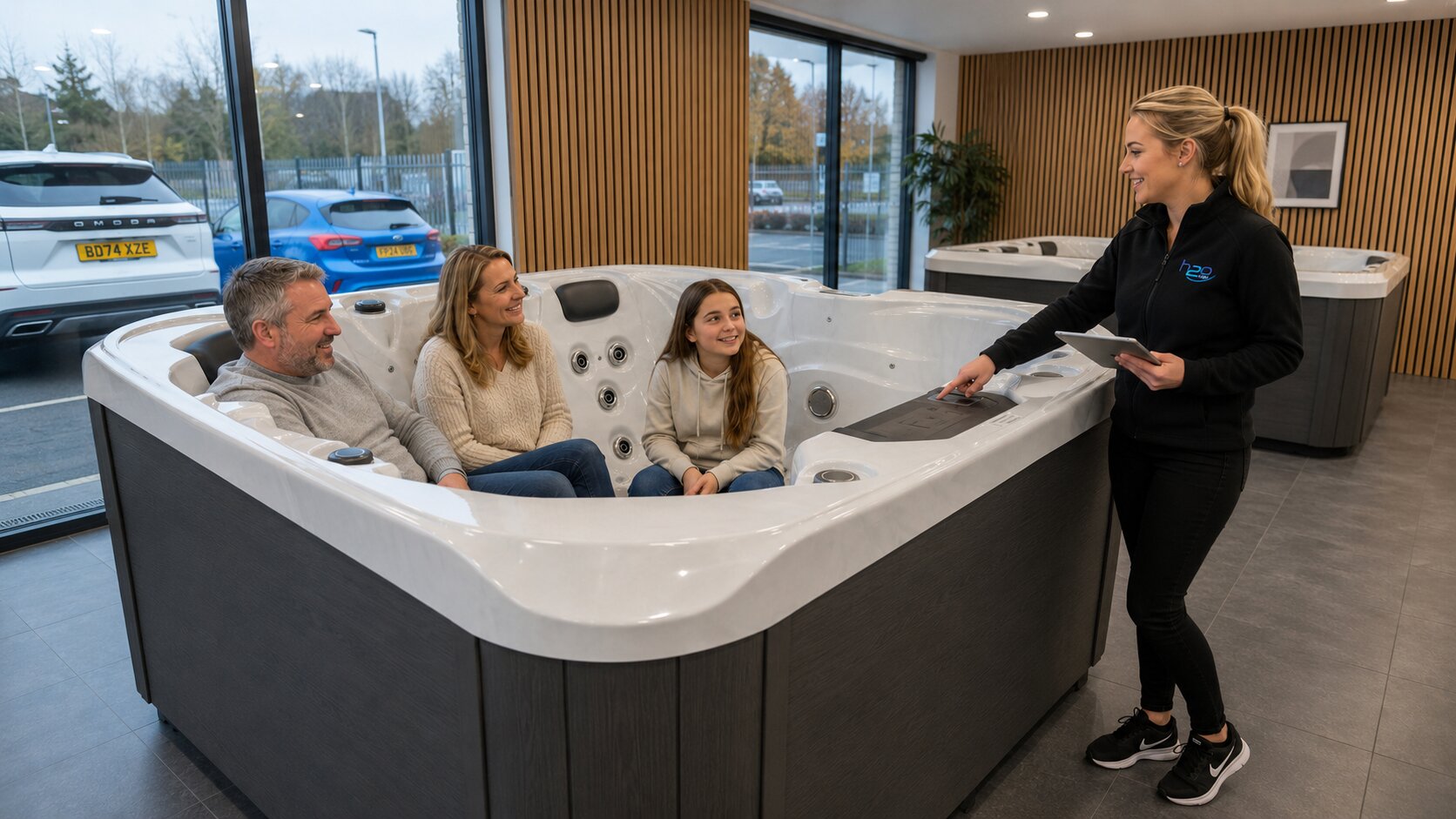
If you expect five or six adults most weekends, sit that many adults in the dry spa before buying. Check whether shoulders overlap, whether people can get in and out without everyone moving, and whether the footwell becomes a tangle of legs. A spa advertised for seven or eight may be the more realistic entertaining choice, but only the actual layout can confirm it.
Also consider the electrical supply. Larger spas and more powerful layouts are often associated with different supply requirements, so compare our guide to 13A and 32A hot tubs before installation planning.
Hot tub size for tall people: check the person, not the brochure
This is where many size comparisons fall short. A hot tub can look large on paper and still be uncomfortable for someone who is 6ft or taller. The outside length of the cabinet is not the usable length of the lounger or seat.
A 200cm or 210cm-wide spa does not provide a 200cm or 210cm-long body space. Cabinet structure, insulation, the shell wall, the curved backrest, the footwell and the shape of the seat all reduce the internal usable length. The lounger may also be set diagonally or finish well before the opposite cabinet wall.
That means a person who is 6ft (about 183cm) cannot safely assume that a spa with an outside dimension greater than 183cm will fit. Actual body position matters more than the headline measurement.
Why some hot tub loungers are too short
A lounger should support the body in a natural reclined position. If it is too short, a tall user may find that the headrest sits between the shoulder blades, neck jets hit the wrong place, knees rise awkwardly or feet press hard against the end of the shell. If the angle is wrong, the person may slide forwards to create legroom and lose the intended massage position.
Check these four points:
- Shoulders and head: the head should meet the headrest naturally while the shoulders sit below the waterline and the upper jets reach the intended areas.
- Hips and lower back: the body should settle into the moulding without being forced forwards or sideways.
- Knees: the legs should bend comfortably without the knees being pushed high or squeezed into the shell.
- Feet: the heels or soles should have secure support without being jammed against jets or into the footwell.

Seat depth matters for tall users too
Lounger length is only part of the problem. A shallow upright seat can leave a tall person’s shoulders exposed, while a short seat base can push the knees upwards. A deeper shell may help, but the relationship between seat base, back angle, waterline and headrest is more important than overall cabinet height.
We stock specific hot tubs selected with people who are 6ft and above in mind because plenty of spas on the market are simply too short for them. That does not mean every tall buyer needs the biggest cabinet. It means the seat geometry and usable internal length must be checked against the individual.
Shorter users need a proper fit as well
A very deep lounger can be uncomfortable for a shorter person. If their feet do not reach the end support, the buoyancy of the water can make them float forwards or upwards. Neck jets may sit too high and the waterline may reach the chin or face.
This is why the tallest and shortest regular users should both test the spa. A mixed-depth layout can be more useful than one made entirely of deep seats.
Lounger or all-seater: which makes better use of space?
A lounger provides full-body support and can deliver jets to the back, legs and feet, but it consumes more shell length than an upright seat. In a smaller spa, that may reduce realistic group capacity. Twin loungers reduce the number of upright positions further, which can be ideal for a couple but less practical for a sociable family.
An all-seater layout often provides more flexible capacity and a more open central footwell. It can be better for conversation and for households with a wide range of heights. The right choice depends on who will use the spa most often, not which layout looks most luxurious in a photograph. Our existing guide explains the main hot tub seating options in more detail.
External dimensions are not the whole space requirement
Once you have a comfortable internal size, check the installation space. The base must support the full filled weight and remain level. Read our guide to choosing a hot tub base before finalising the footprint.
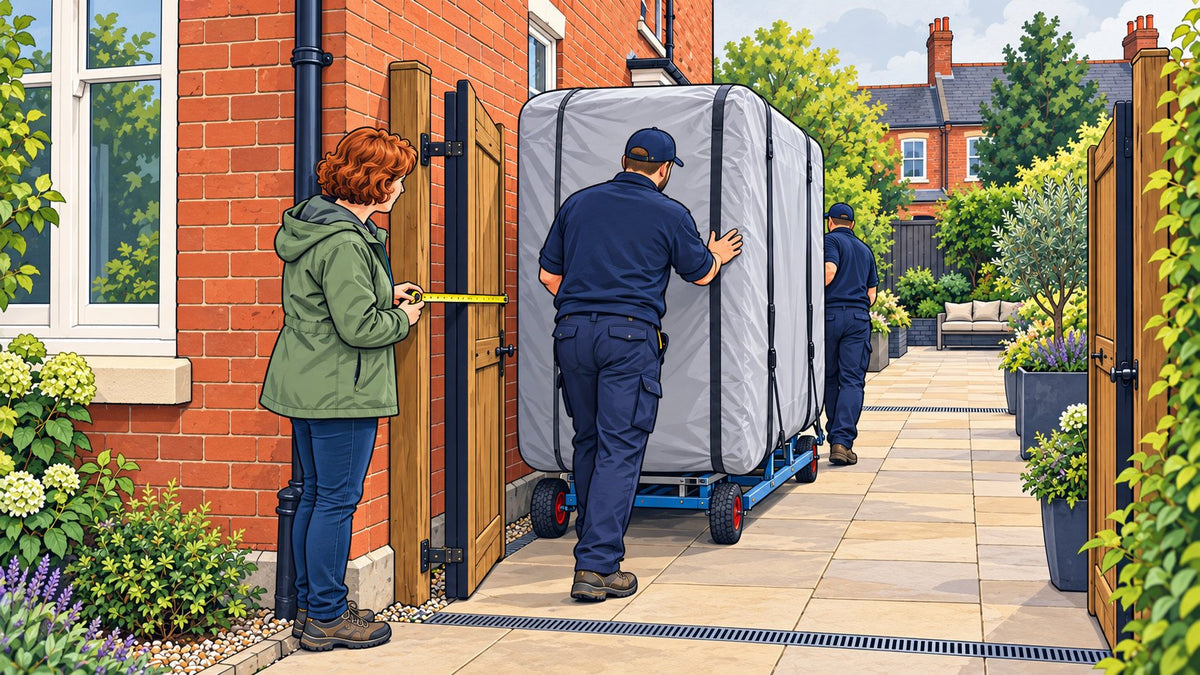
Allow for the cover to open, steps to sit securely and service panels to remain accessible. Measure gates, passages and turns along the delivery route as well as the final position. A cabinet that fits the patio may not fit through the side access.
It is worth combining these practical checks with our broader guide to what to consider when buying a hot tub.
Use a realistic showroom fit test
The best sizing check is simple: sit in the actual hot tub before buying. A dry test in an empty spa reveals much more than a brochure drawing. If a wet test is available, it also shows how buoyancy changes the fit.
Bring the tallest and shortest people who will use it regularly. Try every main seat and the lounger. Then ask yourselves:
- Can everyone sit without overlapping shoulders?
- Do feet have a natural place without crowding the footwell?
- Do headrests and jets meet the right parts of the body?
- Can people enter and leave without the whole group moving?
- Is there at least one comfortable position for each regular user?
If guests matter, repeat the test with the number of adults you realistically expect, not just two people imagining the remaining places.
Common hot tub sizing mistakes
- Buying by advertised seats alone: count the adults who fit comfortably, not only the moulded positions.
- Using outside length as lounger length: the shell and cabinet take up a significant part of that measurement.
- Testing only the average-height buyer: the tallest and shortest regular users may experience the same seat very differently.
- Choosing for rare parties: a very large spa may be unnecessary if two people use it almost every day and guests visit rarely.
- Forgetting access and servicing: the spa must fit the route, base and working space, not just the final rectangle.
Frequently asked questions
Is a six-person hot tub comfortable for six adults?
Sometimes, but not always. Six refers to the number of seating positions. Broad shoulders, a small footwell, close seat spacing or a large lounger can make four or five adults the more realistic comfortable capacity.
Should a couple buy a two-person or four-person hot tub?
A two-person spa suits limited space and consistent use by one couple. A three or four-person spa usually offers more seating choice and room for occasional guests. Test both because a compact four-seater can still feel tighter than a well-designed two-seater.
What size hot tub is suitable for a family of four?
A five or six-seat model is often a sensible starting point, particularly if the children are growing or adults want different seat depths. The right answer still depends on the shell layout and the size of each user.
Will a standard hot tub lounger fit someone over 6ft?
Do not assume it will. Check the usable lounger length and sit in the actual shell. The shoulders, head, hips, knees and feet should all settle naturally. Overall spa dimensions are not a substitute for this test.
Does a deeper hot tub suit taller people?
It can help keep the shoulders covered, but depth alone does not guarantee comfort. Seat-base length, back angle, foot support, headrest position and jet placement all affect the fit.
What size hot tub should I buy? The practical answer
Choose for the people who will use the hot tub most weeks, then allow extra room for regular guests. Couples often suit two to four advertised seats, families of three or four may prefer five or six, and frequent groups should compare larger open layouts. In every case, treat the advertised capacity as a starting point rather than the final answer.
For anyone around 6ft or above, make lounger length and seat geometry a central part of the decision. Sit in the actual spa, check where the headrest and jets meet the body, and make sure the knees and feet are supported without crowding. A correctly fitted hot tub will feel comfortable from the first soak and remain useful as the household changes.
For more practical ownership and buying guidance, visit the H2O Hot Tubs homepage.
Share: