

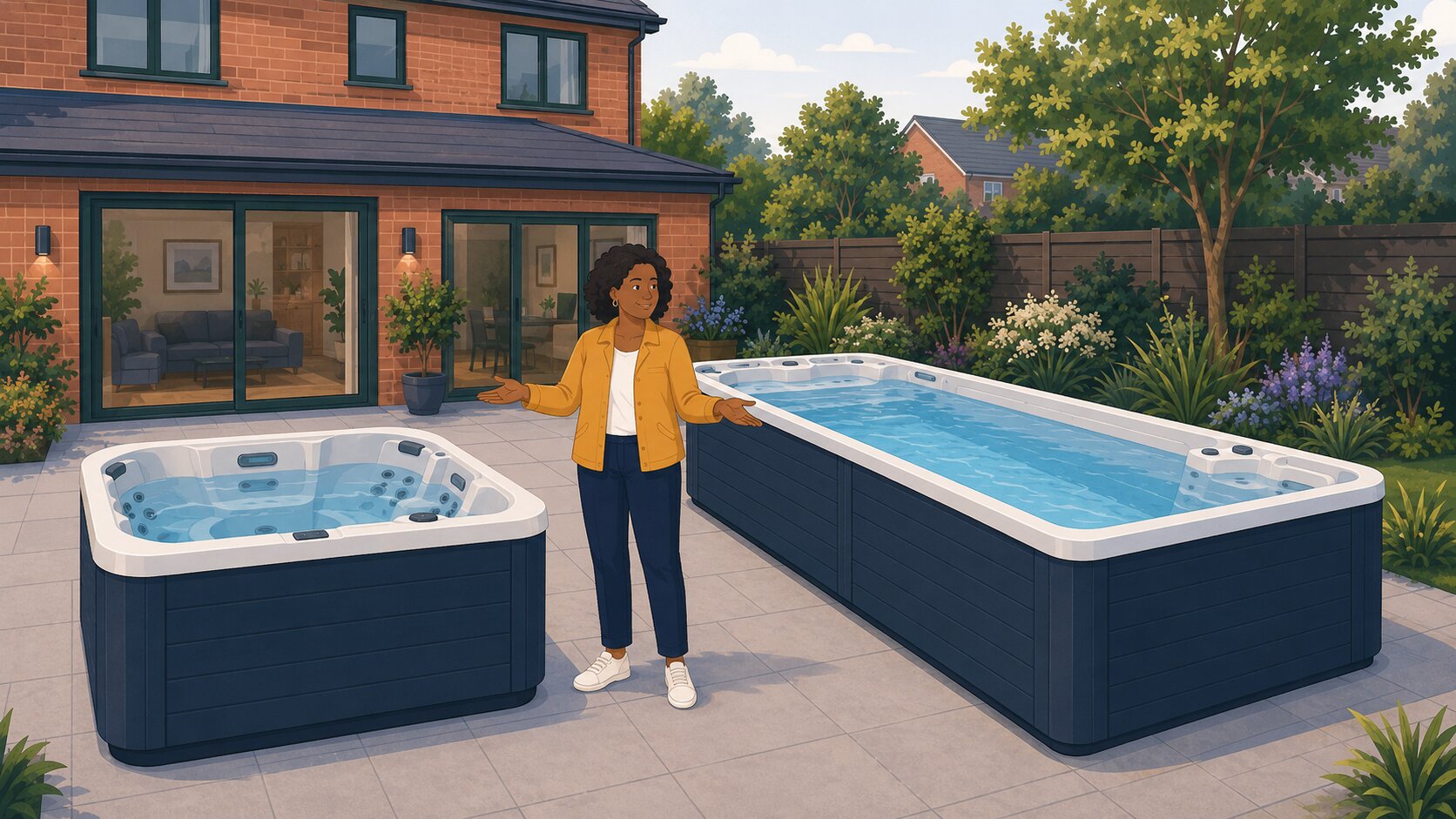
A hot tub and a swim spa both give you heated water, hydrotherapy jets, filtration, an insulated cover and the option of year-round outdoor use. The big difference is what each product is built to do.
A hot tub puts seating, warm-water relaxation and massage first. A swim spa adds open water and a counter-current for continuous swimming. Many include hydrotherapy seats, but that doesn't make every model identical to a hot tub.
A dual-zone swim spa adds a physically separate hot-tub area with independent temperature control. That matters if you want exercise water and a hot place to relax.
If the category is new to you, read what a swim spa is and how it works. You can also compare our swim spas while working through this guide.
What is the main difference between a swim spa and a hot tub?
The simplest answer is purpose. A hot tub is designed mainly for sitting and soaking. Its shell is filled with seats, loungers and targeted jets because relaxation and hydrotherapy are the main event.
A swim spa needs open water in front of its current. The swimmer stays broadly in place while water moves towards them. That is why the cabinet is longer and more of its interior remains open.
The broad comparison looks like this:
- Hot tub: relaxation-first, with dedicated seating and warm-water hydrotherapy.
- Single-zone swim spa: swimming-first, with seating and relaxation in the same body of water.
- Dual-zone swim spa: a separate swimming area and hot-tub area with independent temperatures.
None is automatically better. The right answer depends on whether you primarily want to relax, swim or genuinely do both.
Can you swim in a hot tub?
Not in the conventional sense. A hot tub doesn't have enough uninterrupted space or a counter-current designed to hold a swimmer in position.
You can stretch, move and perform gentle water-based exercises in some hot tubs. You cannot settle into front crawl and keep going for twenty minutes. The shell, seats and jets are arranged around seated use rather than swimming.
A swim spa solves the space problem with an open exercise area and solves the distance problem with flowing water. You swim against the current instead of travelling from one end to the other.
How does swimming in a swim spa work?
A swim system pushes water towards the swimmer through swim jets, broad-current outlets or river-style jets. You increase or reduce the resistance to suit your pace, then swim while staying within the same part of the spa.
This can work for beginners, recreational swimmers and regular fitness users. Performance still varies. Current strength, smoothness, width and control matter at least as much as cabinet length. Our guide to choosing the right swim spa explains how to assess the system alongside size, seating and build quality.
Which is better for exercise?
A swim spa has the clear advantage for swimming and sustained water-based exercise. Depending on the design and accessories, it can support continuous swimming, aqua jogging, water walking, resistance work and general aquatic fitness.
A hot tub is built around sitting. Its warm water may feel pleasant before or after exercise, but the product itself is not a substitute for a swimming or fitness area.
That doesn't mean it replaces every gym session or pool. Its value depends on whether you will use the current rather than treating the open water as an unusually spacious footwell.
Which is better for hydrotherapy and relaxation?
A hot tub has an advantage if relaxation is your only priority. Its interior is used for seats, loungers and targeted jets rather than preserving a swimming lane.
Many swim spas still provide meaningful hydrotherapy. The Electra 3.6m / 12ft Swim Spa combines its swimming area with seating and 26 hydrotherapy jets. The Nova 4m / 13ft Swim Spa has dedicated relaxation seating at one end and 24 hydrotherapy jets.
Electra and Nova are single-zone products. Their swimming and seating areas share the same body of water and the same temperature. That is the compromise to understand, not whether they have massage jets.

Can a swim spa really replace a hot tub?
Sometimes. It depends on the design and what you expect from a hot tub.
A single-zone swim spa can give you warm water, seating, hydrotherapy jets and a relaxing place to sit after exercise. For plenty of owners, that is enough. The limitation is that one temperature has to work for every use.
Water that feels comfortable for swimming may feel cool for a long soak. Typical hot-tub temperatures can feel too warm once you work hard against the current. If you accept a middle ground, a single-zone spa can serve both purposes. If you want both experiences at their preferred temperatures simultaneously, look at dual-zone.
Water temperature is one of the biggest differences
Hot tubs are usually kept relatively warm because users are sitting still. A swim spa may be run cooler because active movement produces body heat. The harder you exercise, the less appealing very hot water becomes.
There is no single temperature for every swimmer or season. Exercise intensity, preference and outdoor conditions all matter. A single-zone spa asks the household to choose one setting. It is less convenient if one person wants to train while somebody else wants a hot soak there and then.
What is a dual-zone swim spa?
A true dual-zone swim spa contains two physically separate bodies of water. One compartment is built for swimming and exercise. The other is a dedicated hot tub with its own seating and massage jets.
Each area has independent temperature control. The swimming zone can stay cooler while the hot-tub zone remains warmer for seated relaxation. They are not simply two ends of one shared shell.
This is different from a single-zone swim spa with seats at one end. Those seats can offer excellent hydrotherapy, but they still share the swimming water.
Vesta: a swim spa and hot tub in one unit
The Vesta 5.8m / 19ft Swim Spa is H2O's real-world dual-zone example. One end is a dedicated swimming compartment. The other is a physically separate hot tub.
Both zones have their own controls. One person can swim in cooler water while somebody else relaxes in the warmer hot-tub end. No waiting for the shared water to change temperature, and no argument over whether today is for training or bubbles.
Vesta is the model that most closely answers: can I have a swim spa and a proper hot tub without installing two separate products? The trade-off is a larger footprint and a more substantial installation.

Swim spa vs hot tub size
Hot tubs usually occupy a compact square or rectangular footprint because their internal space is arranged around seats. Swim spas are significantly longer because they need open water in front of the current.
H2O's Electra is approximately 3.6m / 12ft long, Nova is 4m / 13ft and Vesta is 5.8m / 19ft. A conventional hot tub may fit comfortably in a garden where even a compact swim spa would dominate the patio.
External length doesn't tell you how much swimming room you get. Seats, steps, shell mouldings and, in a dual-zone model, the separate hot-tub compartment all use some of the cabinet. See our complete guide to swim spa sizes before marking out a base.
How much garden space do you actually need?
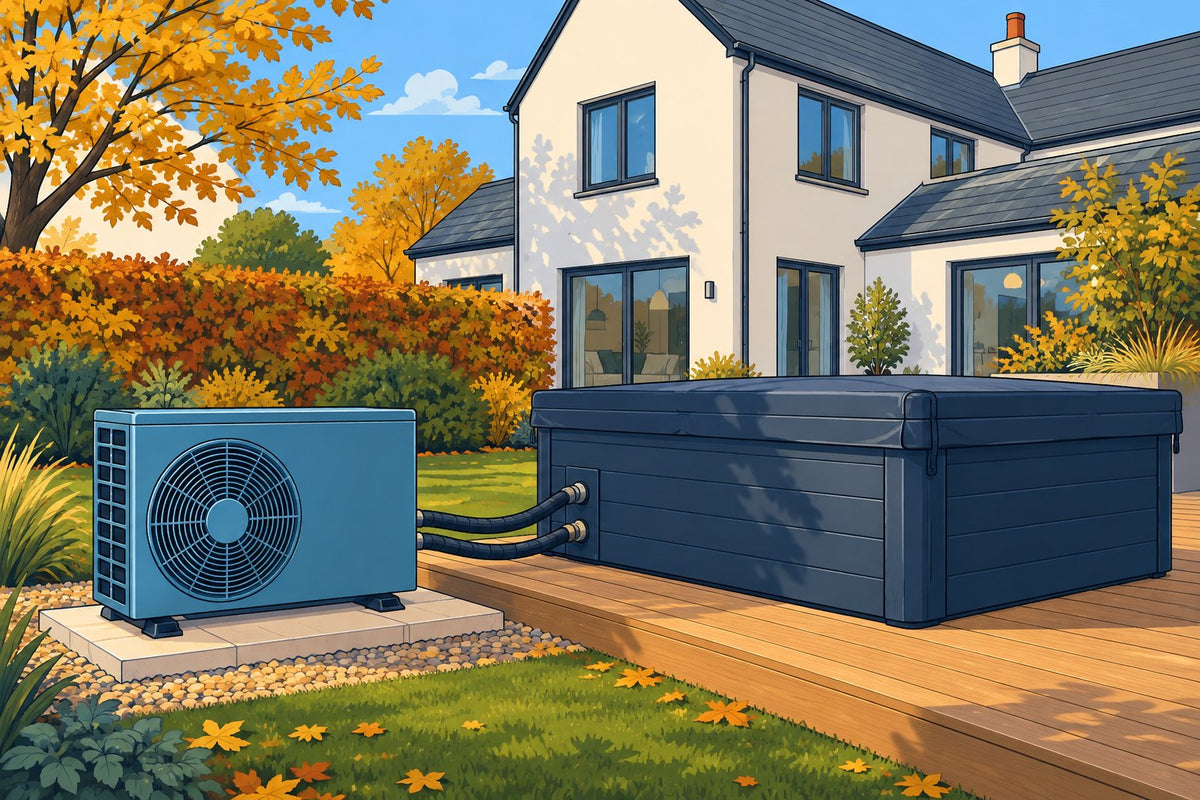
Measure more than the product. Both categories need safe access, steps, cover movement and room to remove cabinet panels for servicing. You may also need space for a cover lifter, drainage, electrical equipment and an optional heat pump.
A 4m gap does not necessarily make a practical home for a 4m spa. The cabinet might squeeze in while the cover and engineer are left to develop new talents.
Our swim spa installation guide covers bases, electrical preparation, crane access, cover clearance and future servicing.
Which is easier to install?
A conventional hot tub is usually simpler. It is smaller, lighter when empty and needs a smaller structural base. Some models use an appropriate plug-and-play supply, while others need a dedicated hard-wired electrical connection.
A swim spa is longer, heavier and often weighs several tonnes once filled. The base has to support the complete loaded weight, not merely the empty shell shown in a brochure. Electrical requirements are also more substantial because swim spas use larger pumps, heaters and additional equipment.
That does not make a swim spa impractical. It means the groundwork, access and electrics should be planned before delivery rather than discovered by the crane driver.
Crane delivery and access
Swim spas normally need mechanical lifting into position. A product several metres long and more than two metres wide is not travelling through an ordinary side gate.
Depending on the property, installation may involve a HIAB or crane lifting over a wall, garage or house. Hot tubs occasionally need the same treatment, but it is less inherent to the category. Ask H2O to assess the route before landscaping is finished.
Base requirements
Both products need a flat, level and structurally suitable foundation. Do not assume an existing patio can carry either one without checking.
A swim spa's greater water volume creates far more loaded weight. The base must be designed around the chosen manufacturer's specification, along with any surrounding steps, decking or access area.
Electrical requirements
Electrical needs vary by model. Hot tubs range from suitable plug-and-play models to higher-amperage hard-wired systems. Swim spas generally need more substantial supplies because they contain more powerful pumps and larger heating systems.
Dual-zone products can be more demanding again because they contain equipment for two water environments. Always confirm the exact requirements of the selected model with H2O and use a qualified electrician.
Swim spa vs hot tub running costs
There is no honest universal monthly figure. A swim spa generally contains much more water, has a larger exposed surface area and may use more powerful pumps. It will usually need more energy than a similarly efficient hot tub.
The size of the difference depends on insulation, cover quality, water temperature, use, season, electricity tariff, filtration, heater specification and whether a heat pump is fitted. A poorly insulated hot tub kept very warm can still be expensive to run.
Compare the products you might actually buy rather than relying on a category-wide promise. Our guide to swim spa running costs in the UK explains the variables. For purchase, groundwork and delivery budgeting, see how much a swim spa costs in the UK.
Which needs more maintenance?
The water-care principles are similar. Both products need sanitiser, balanced pH, filtration, filter cleaning, water changes and cover care.
A swim spa may have more filters, pumps and shell area, so cleaning can take longer. Initial heating also tends to take longer because there is more water. Once warm, both categories normally maintain temperature rather than starting from cold before each use.
A dual-zone spa has two separate bodies of water, so each zone needs testing and treatment.
Which is better for socialising?
Give this round to the hot tub if sitting together is the main goal. Its interior is designed around seats, eye lines and shared warm-water relaxation. A single-zone swim spa may have fewer conventional seats because open swimming space takes priority.
Layouts vary, so seat count and comfort should be checked rather than assumed. A dual-zone model can provide a more familiar social hot-tub area while keeping the swimming compartment separate.

Which is better for families?
A swim spa offers more variety for swimming, exercise and relaxation. A hot tub makes more sense when the family mainly wants to soak and socialise, especially where garden space is limited.
Neither product is a toy. Children and inexperienced swimmers need suitable adult supervision, and owners should follow the manufacturer's guidance on use, water temperature, covers and access.
Can a swim spa replace a swimming pool?
A swim spa can provide continuous resistance swimming in a far smaller space than a conventional pool. It is also self-contained and designed to be covered and heated.
It is not the same experience as swimming lengths, diving, hosting a large group or moving freely across a broad pool. If those activities matter, the compact footprint comes with a real compromise.
Which is better for year-round use?
Both can work throughout the year when they are installed, insulated and maintained correctly.
A hot tub feels especially natural in winter because you are sitting in warm water. A swim spa can also run year-round, but swimming comfort, heating demand and handling a larger cover need more thought.
Swim spa vs hot tub: advantages at a glance
| Consideration | Hot tub | Swim spa |
|---|---|---|
| Swimming | No continuous swimming | Yes, against a counter-current |
| Hydrotherapy | A core strength | Usually available, layout varies |
| Exercise | Limited | A core strength |
| Temperature | Warm, relaxation-led | Flexible, or independent on dual-zone models |
| Garden footprint | Usually smaller | Significantly longer |
| Installation | Usually simpler | More substantial planning |
| Crane delivery | Sometimes | Usually |
| Energy demand | Generally lower | Generally higher |
| Social seating | Usually seat-focused | Depends on the layout |
| Dual temperatures | Not applicable | Available on dual-zone models |
Specifications vary by model. This is a category-level comparison, not a guarantee about every product.

Who should choose a hot tub?
A hot tub is probably the more sensible choice if you mainly want warm-water relaxation, dedicated hydrotherapy, plenty of seating and a comparatively compact installation.
If you have little interest in swimming, taking up much more garden space for a counter-current you will rarely switch on makes no sense. You can explore H2O hot tubs if relaxation is the clear priority.
Who should choose a swim spa?
A swim spa suits buyers who genuinely want continuous swimming, water-based fitness and enough versatility for both exercise and relaxation. You will need the garden space and should be comfortable with the more substantial base, electrical and delivery planning.
If that sounds like your household, browse our swim spa range and compare the current, seating and dimensions rather than choosing by length alone.
Who should choose a dual-zone swim spa?
Choose dual-zone when swimming and traditional hot-tub relaxation carry equal weight and you do not want to compromise on water temperature. It is particularly useful when different people may use both areas at the same time.
You also need enough physical space and electrical capacity. Vesta solves the temperature compromise, but it would be excessive for somebody who only wants the occasional gentle paddle before a soak.
Swim spa vs hot tub FAQs
What is the difference between a swim spa and a hot tub?
A hot tub is designed mainly around seating, warm-water relaxation and hydrotherapy. A swim spa adds an open exercise area and counter-current for continuous swimming.
Can you use a swim spa as a hot tub?
Many swim spas include hydrotherapy seating and can offer a hot-tub-like experience. Single-zone models share one temperature, while a dual-zone model has a separate hot-tub compartment.
Can you swim in a hot tub?
No, not as you can in a swim spa. A conventional hot tub lacks the open space and counter-current needed for continuous swimming.
Do swim spas get as hot as hot tubs?
Many can operate at warm temperatures, but strenuous swimming is usually more comfortable in cooler water. A dual-zone swim spa lets the swimming and hot-tub areas run at different temperatures.
Is a swim spa bigger than a hot tub?
Usually considerably. A swim spa needs an open swimming area and is commonly several metres long.
Is a swim spa more expensive to run than a hot tub?
It generally needs more energy because it contains more water and may use more powerful equipment. The real difference depends on insulation, temperature, use, weather and heating method.
Is a swim spa harder to install?
It normally needs more planning because of its size, loaded weight, base requirements, electrical supply and crane delivery.
Is a dual-zone swim spa the same as a swim spa with seats?
No. A true dual-zone model has two physically separate bodies of water with independent temperatures. A single-zone spa with seats still shares one body of water.
Should I buy a hot tub or a swim spa?
Choose according to intended use. If relaxation and hydrotherapy come first, a hot tub may make more sense. If swimming and exercise matter, choose a swim spa.
Swim spa vs hot tub: which is right for you?
If you only want warm-water relaxation and hydrotherapy, buy a hot tub. There is little point giving up substantially more garden for swimming capability you will not use.
If swimming or water-based exercise is a genuine priority, a hot tub cannot do the same job. A swim spa gives you the counter-current and open exercise area, with hydrotherapy seating available on many models.
If you want proper swimming conditions and a proper hot-tub experience at the same time, a dual-zone model such as Vesta removes the compromise. Choose around what you will actually do, not the longest specification list.
Share: